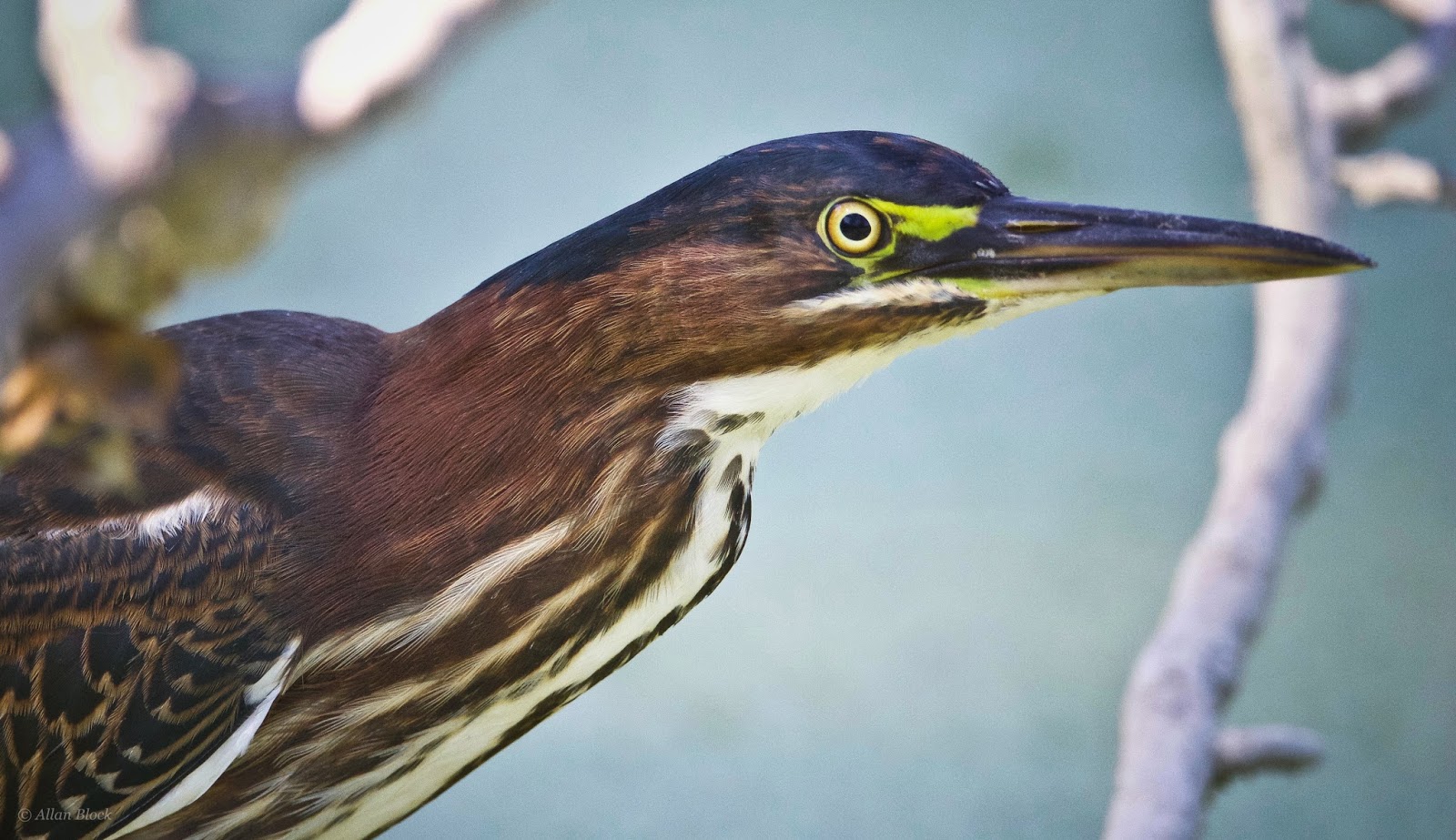
Showing posts with label green heron. Show all posts
Tuesday, March 20, 2018
Green Heron & Frog
A Green Heron snatches a tadpole bullfrog from a Sweetwater Wetlands retention pond.
It's curtains for a tadpole... brunch for a heron.
A few sharp shakes put and end to the tadpole's squirming, then to be swallowed whole.
Green Herons prefer hunting near the protection of dense vegetation. It's there they find their favorites of fish, amphibians, snails and even an occasional rodent.
Downing this slippery, slimy soon-to-have-been frog triggers a need to readjust.
A whole body shudder arranges his new meal and seemingly anything else misadjusted.
A short test flight to a nearby branch settles his stomach even further.
Yet more importantly, his landing nearby assures me I wasn't bothering him by being too close.
Allan
Credit: Cornell Lab of Ornithology, All About Birds
Thursday, March 8, 2018
Green Herons Battle
Dropping sharply from the air, an adult Green Heron attacks a juvenile. The juvenile showed mild concern toward the approaching adult, until it suddenly turned to panic.
The attack seemed unprovoked from my point of reference standing on the edge of this slowly draining water hole. Both birds had appeared to be tending to Green Heron business on opposite sides of the pond in mutual harmony.
A platform overlooks this area known as Sweetwater Wetlands. The pond is being drained for a controlled burn to remove excessive vegetation. Still, it seems large enough for all to coexist peacefully. A Great Egret and a Snowy Egret showed no animosity towards each other and foraged peacefully.
Unfortunately, somehow, something provoked the adult into attacking the juvenile.
It's likely the Green Heron's actions raised the pond inhabitants' anxiety level a few notches with their displays of aggression and posturing.
The adult on the left was upset at the juvenile on the right, possibly for the younger's mere presence at the pond.
That's only my observation, but Green Heron the Younger seems to be receiving a little foot action to deliver that message.
He retreats only to land across the pond at the exact spot where the adult left to initiate his attack.
Now the adult Green Heron gets to claim this lovely new section of mudflats.
I wonder how he feels about that?
Allan
Credits: Sibley's Guide to Birds
Thursday, August 18, 2016
Green Heron with Frog
Startled by a perceived threat, a Green Heron comes to attention...crest raised...eyes fixed.
It's 11a.m. on the Milwaukee River in Mequon, WI.
A real threat didn't materialize so all is quiet again...crest lowered.
It's back to searching for food on the lily pad covered river.
(Click any picture to enlarge all.)
This bite-sized crustacean was a suitable snack...several more would make a meal.
Green Herons eat from a wide variety of aquatic life, mainly fish, but also including spiders, snails, reptiles and amphibians.
Today an amphibian is in his future...a bullfrog!
Stabbed straight through, the frog, if alive, is mortally wounded. It was just a matter of removing the frog from his bill and positioning it headfirst for swallowing. This took six minutes of juggling, tossing and twisting to get the frog aligned just right.
The bullfrog has given up and accepted his fate. He hangs limp or expired. The heron has his meal.
Going...going...
All gone!
Now you might say the Green Heron has a
'frog in his throat'.
Allan
Credit: Cornell Lab of Ornithology, All About Birds
Sibley Guide to Birds
Monday, August 1, 2016
Green Herons
Call this a picnic at the river for two young Green Herons patrolling the waters below Thiensville Village Park dam, Thiensville, Wisconsin.
In knee deep water (s)he was finding many good items to eat ranging from tiny insects to more meaty fare.
Her companion, possibly a sibling, hunts from a snag out in the river. Red-winged dragon flies were everywhere this day and the unlucky ones were on the menu.
Fishing is always good, but it required some intense concentration to be successful.
Whether it was good luck, skill or the profusion of prey, these similar-sized heron companions were having a stellar day. Green Herons hunt by day or night, usually in four inches of water or less. They eat from a wide variety of water borne creatures including fish, crustaceans, spiders, reptiles and rodents.
This forlorn creature was plucked from the shoreline never to be seen again.
Still small and immature and crow-sized for comparison, Green Herons grow into football sized adults.
A stocky body conceals a surprisingly long neck. Waiting motionless while unsuspecting prey venture within range, the Green Heron either grasps or spears prey.
At which point it is game-over.
Allan
(Click any picture to enlarge.)
Credit: Cornell Lab of Ornithology, All About Birds
Sunday, June 1, 2014
Lion’s Den Gorge Nature Preserve
A Baltimore Oriole pries open a blossom to see what's crawling inside. The sun is
rising over the Lion’s Den Gorge Nature Preserve on this last day of May 2014.
Hundreds of birds are darting about searching for food…breakfast if
you like.
No one is keeping a tally of which blossoms are visited, so each bird inspects every blossom in turn...an ongoing scramble of activity. These inspections are repeated thousands of times over millions of blossoms covering the seventy-three acre nature preserve. It's natural theater.
This worm show goes on every morning about this same time.
A Cedar Waxwing is working a tree nearby. The Lion’s Den Gorge Nature Preserve is
located in the Town of Grafton. Sited along the Lake Michigan shoreline, it’s
especially busy at this time of year.
Multiple species of birds are traveling to their summer nesting grounds. Some birds will stay and make Lion's Den their home, but most use it as a stopover on their annual spring migration elsewhere.
Birds are most active and approachable in the morning. If
you want to see birds up close, you will have to get up early.
Some people come to walk the sandy beach or the bluff overlooking the lake,
others come to walk their dogs. Dogs on leashes are welcome.
It is a quiet, peaceful place at sunrise.
I appreciate the long daylight hours of May, when it’s only
the birds and me.
With newly budding trees, the birds stand out against a slowly brightening sky.
If you don’t see birds, listen for them.
The Red-eyed Vireo is a dependable singer. It makes no difference if it’s morning or evening, the Red-eyed Vireo will let you know where he is, if you follow his song.
The Red-eyed Vireo is a small stocky songbird with an olive
green back, white belly and white eyebrow. He likes the midlevel
branches when searching for food. He sings while gleaning leaves for caterpillars.
He’s not particularly colorful or ‘drop dead’ gorgeous, but he has a nice song and beautiful dark red eyes.
His red eye shows you he is watching you, so move
slowly and wear muted woodland colors.
Whites and bright colors startle birds and will lessen your chances of
getting a good up-close view.
The Lion’s Den Gorge Nature Preserve is adjacent to the
USFWS Wildlife Production Area to the north. Lake Michigan forms the eastern
boundary.
You may find a Green Heron patrolling these waters. Green Herons eat aquatic life, so look for one at the edge of the pond.
Along with the Baltimore Oriole you may find an Orchard
Oriole in the lowlands surrounding a pond.
The Lion’s Den Gorge Nature Preserve may be the stopping point in this Orchard Oriole’s migration. Wisconsin is near the top of the Orchard Oriole range.
They won’t be here for long though. They will be traveling back to Central America for the winter by mid-July.
The Lion’s Den Gorge Nature Preserve may be the stopping point in this Orchard Oriole’s migration. Wisconsin is near the top of the Orchard Oriole range.
They won’t be here for long though. They will be traveling back to Central America for the winter by mid-July.
This Orchard Oriole calmly rested as I watched him. It was hard to tell if he
just arrived, just ate or was just worn out after a long flight. If he searched
for caterpillars this morning, I didn’t see him do it. He was happy where he was and felt no need to fly away. He sat quietly for a long time just soaking up the morning sunshine.
(Click any picture to enlarge)
This Yellow Warbler, singing at the rising sun, offers a double treat.
His sweet song combined with his bouncy antics accounts for two of the many joys of nature.
As
he sings and searches the bushes for bugs, he’s unaware that his yellow-on-yellow color matching with the leaves makes the early morning even more special.
Allan
Credits:
Cornell Lab of Ornithology, All About Birds
Sibley Guide to Birds, Second Edition
Wednesday, August 28, 2013
Green Heron, Lion’s Den Gorge Nature Preserve
Catching a fish is an acquired skill, even for a Green Heron.
When I turned around, this juvenile Green Heron was
marching up the boardwalk towards me.
I was at the Lion’s Den Gorge Nature Preserve, north of Milwaukee, south of Port Washington and along Lake
Michigan’s shoreline.
Unaware of me when he landed, he began patrolling the edge of
the boardwalk intent on catching something good to eat in the water. Green
Herons have a surprisingly long neck when it's not tucked into a football-sized compact
body.
Being a juvenile, he may have not yet figured out how he was
going to land a fish or a frog from the boardwalk. I'm not sure he'd thought this through, as this would present a new challenge for him.
Never mind, strolling the boardwalk is easier.
He occasionally peered over the edge, excited by movement in
the weeds and water. Whatever he was looking at was well out of his reach, so he may have just been reacting on instinct or testing out his stalking techniques for use later.
Stepping along the boardwalk he’d replay the same stop and
stare stance over and over, contracting his neck each time in reconsideration. I suspect this was an exercise
somewhere between practice and play.
Meanwhile, an adult Green Heron was hiding behind a nearby
tree. I have no knowledge of these
two Green Herons' relationship, but I’d like to think it could be an adult
parent still keeping an eye on an offspring. It’s an observation and a reasonable speculation, but totally
unfounded.
Someday junior here will share the blue, green and wine colors of adulthood, but for now he’s
still in his adolescent plumage.
More camouflaged than colorful, this may be a 1st
year individual. His camouflage would
serve him better if he weren’t strutting down the boardwalk though, but he'll learn someday. He looks to be well-fed, independent and somewhat capable of fishing on
his own.
Allan
Saturday, April 6, 2013
Green Heron / Tricolored Heron
In front of me a Green Heron was inching his way out of the reeds in big, slow steps. Behind me was a Tricolored Heron doing the same. Both had spotted something 20-feet away in the water. To get there
without spooking it was their challenge.
I was in Huntington Beach State Park in South Carolina, but
more precisely on a six-foot wide, 100-foot long, 10-foot high well-made and sturdy
boardwalk with handrails, guardrails and a gazebo at the end. The boardwalk, extended
over what one might unkindly call a swamp,
but it was home to countless
creatures including these two herons and even more worrisome… alligators. I was glad to be on the boards.
The Green Heron’s gaze was fixed on something below the
surface. As he neared his target his
pace slowed and he went into a crouch.
I’m sure he was aware something could be watching him wading in the water, too.
I’m guessing here, but the Green Heron looked fairly safe
from an alligator attack in the 6-8 inches of water where he stood.
An alligator would have to be fairly small to conceal itself at those depths, but I’m no expert on alligators.
The Tricolored Heron, too, was approaching something delicious in the water. Taller and more slender with a longer neck and bill he shares some of the Green Heron’s beautiful wine-colored plumage in more muted shades.
The Tricolored Heron’s S-shaped neck, crouched stance and fixed
stare suggested to me that, he, too, was in striking range of something. With his longer legs he could
be in 10-20 inches of water. That
would seem to me (a guy from Wisconsin) to be at alligator-hiding depths,
raising the stakes a notch in this heron’s hunt.
The hunt didn’t last long though. Someway, somehow, he either lost sight, lost interest or
just plain lost the battle, because he quickly returned to the reeds in big steps, empty-billed
and empty-bellied, but alive to hunt another day.
Meanwhile the Green Heron was luckier. He stalked, stabbed and caught a little
fish for his efforts. Not a huge
meal, but the rather risk-free effort in shallower water kept him alive and safe
today.
I too made it back to shore safely, without so much as
a wood sliver.
Allan
Huntington Beach State Park, boardwalk locator
Subscribe to:
Posts (Atom)