Thursday, October 22, 2015

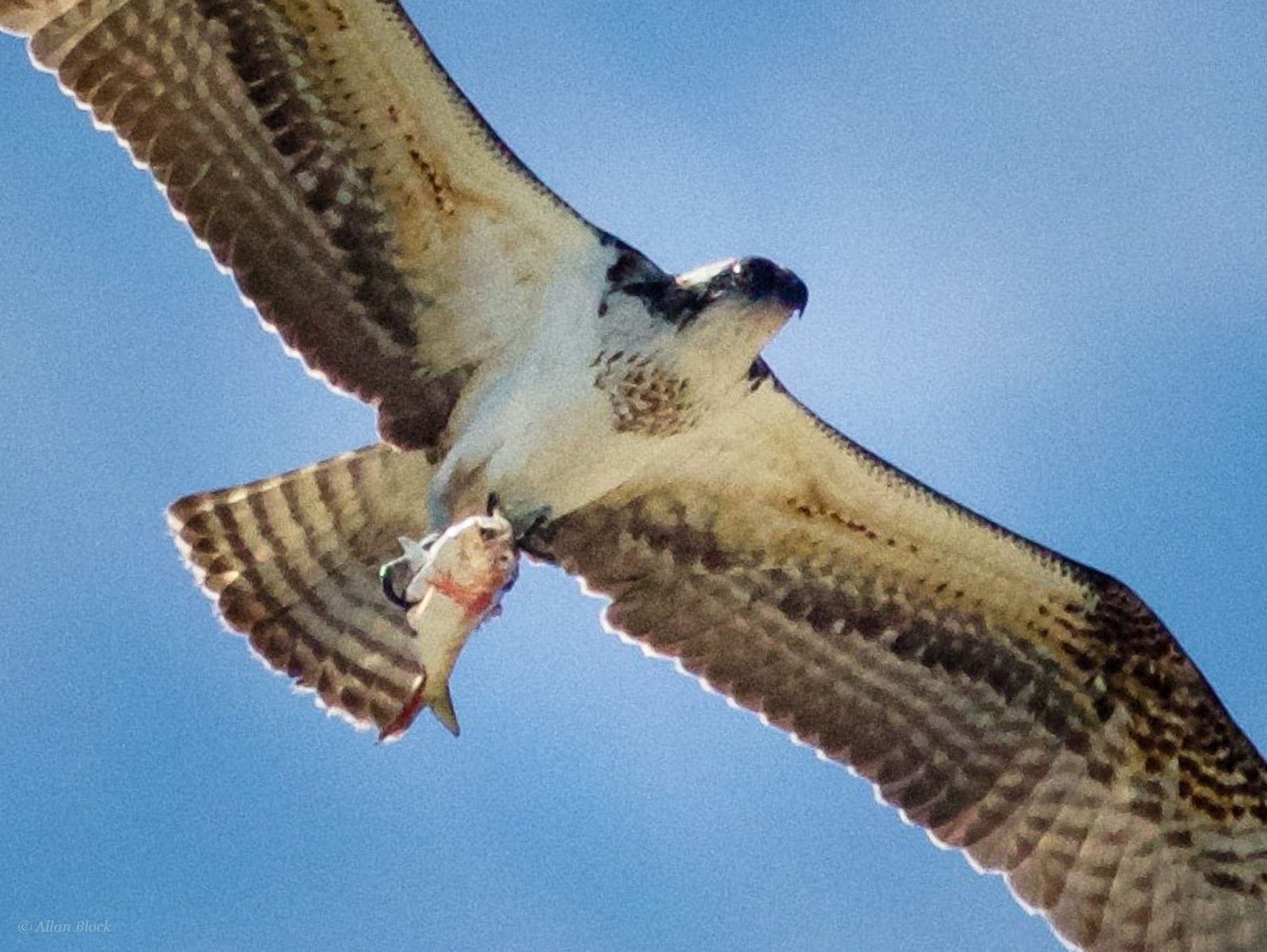
Osprey, North Myrtle Beach, SC


Nature doesn't provide a safety net. If you don't hunt, you don't eat...in this case fish. The osprey is a hawk that fishes. That's unique among hawks. Nearly the entire diet of an Osprey consists of fish.


A wave of  Ospreys patrolled the Atlantic shoreline off North Myrtle Beach, South Carolina. They could have been just passing through or winter residents. As autumn fades and winter approaches it is hard to tell where they will spend their winter.

However, South America is a good guess. With nearly a six foot wingspan, long distance traveling is not a problem for them.

Any lake, stream, marsh or ocean shoreline would suit an Osprey just fine. Ospreys need open water to fish the year round.


                  A female makes an abrupt stop when she spots a fish, hovers briefly and goes into a dive.


The dive is a high speed maneuver of timing and agility. In the plunge there is little room for error. Any miscalculation results in a missed meal.

In this case the fish saw her coming and jumped out of the way at the last second...too late to change course.

Score one for the fish.
Osprey...zero  

                                                                  Nothing to do, but try again.


Powerful wingbeats raise her out of the water. That is no easy task for a heavy wet bird. Ducks and geese have webbed feet for a running start over the water to get airborne. The Osprey talons have no such ability. She only has wing power to rise from the water.


With wings drawn close for maximum speed she sights through her talons to hunt again.

Her concentration is intense. At the last second she will fold her wings behind her body to reduce drag when entering the water.

Even fish three feet beneath the surface are reachable this way.


The Osprey's talons have evolved differently from other hawks. An Osprey's outer talon is reversible allowing it to grasp its slippery prey front and back. When flying they rotate the fish's head forward to minimize wind resistance.


Male and females look alike, although the female wears a brown 'necklace' across her breast.

Allan

Credit: 
Cornell Lab of Ornithology, All About Birds
Wikipedia


Saturday, October 17, 2015

Sanderlings, Myrtle Beach, SC


The surf pounds down hard onto North Myrtle Beach, South Carolina. It seems an unsuitable habitat for such a little bird as the Sanderling. Yet, this ever changing zone at the water's edge is his home.

The Sanderling has an uncanny sense of time and place. In between the dangerous swirling surf and a bone dry beach lies a buried treasure of food.

With a diet of small invertebrates, crustaceans and horseshoe crab eggs, the Sanderling finds food as each wave retreats.

Easy enough...one might think. However, to do this safely one must avoid being pounded by the next incoming wave.

Walking smartly in front of each frothy wave, the Sanderlings entertain and amuse the human beach walkers.


A quick turn around reveals tiny organisms the wave exposed.

It's only a matter of seconds to score this meal or it's gone.

The sun rising from the Atlantic highlights today's bounty. These long distance flyers are just winter residents in Myrtle Beach. They breed and raise their young near the Arctic Circle in far northern Canada. After raising their one brood a year, the monogamous Sanderlings depart to the world's coastlines to continue their wave dodging lifestyle.


Human presence doesn't seem to bother the Sanderlings, although populations are declining. A rough estimate of 700,000 Sanderlings worldwide is the best guess available.

Three Sanderlings search for food a few feet from fishermen. That's unusual behavior in the normally skittish bird communities, but the Sanderlings tolerate people. Sharing may be part of their nature. Sharing and protecting a place we all covet may be a good example for us, too...at the waterline.

Allan
Credits: Cornell Lab of Ornithology, All About Birds

Monday, September 28, 2015

Cooper's Hawk Juveniles


Keeping yourself entertained while your parents are hunting is a struggle for a first-year Cooper's Hawk.

One can only stretch and twist, bounce and bob for so long before it becomes boring.

I discovered two young Cooper's Hawk siblings in Lake Park, Milwaukee, Wisconsin. One examined my every move while the other lost interest in me quickly.

Only able to fly short distances and unpracticed at hunting, they mark time together in a narrow park ravine.


With nothing to do, but wait to be fed, this is a good opportunity to explore one's own body...grooming is important.  Grooming removes dirt, debris and parasites, along with realigning the feather shaft for airworthiness.


People watching helped pass time, too.
If people and dogs stay on the path the Cooper's Hawks were content to hang around, provided a respectable distance was maintained.


But, I strayed one step too close.

That immediately prompted rethinking the margin of safety in the sibling minds.

Would they accept me?

The answer was 'no'.

They both flew away.

I would have enjoyed their company for longer, but it wasn't up to me.

I had all the pictures I was going to get this day.


(CORRECTION: I'm told the last three photographs in this story are not a juvenile Cooper's Hawk, but instead a juvenile Merlin. A Merlin has a faint malar (mustache) and a Merlin's tail is slightly different. I trust this is the case and I am noting it here to reflect that fact. The diet of the Merlin and the Cooper's Hawk is similar, with the Merlin taking other birds, mostly. Thanks to Todd Fellenbaum for sharing his knowledge of birds.)


But, I found juvenile Merlin in Theinsville Village Park, also in September.

He was quite agreeable with having his picture taken. He posed in a tall tree for longer than I cared to remain.

He seems to be giving me the equivalent of a high five, even though he doesn't have the digits for it. I doubt he knows the meaning of the gesture and had little to celebrate quite yet anyway.

 He too was waiting to be fed.


He is too young to hunt. He's safe in the park while his parents find food for him. His father has provided nearly all the food for his mother and him for the past ninety days. 

His care will continue until he's able to hunt the Merlin's main food...other birds and small rodents. 

He watches the people below as well as the fish in the river.  Poised for action yet still lacking the skills of a hunter, he never-the-less displays the potential of a powerful falcon.

(Click any picture to enlarge.)

Allan

Credits: Cornell Lab of Ornithology, All About Birds
The Sibley Guide to Birds, David Allen Sibley

Saturday, September 5, 2015

Cedar Waxwing


From tip-to-tail the Cedar Waxwing is a stunningly beautiful bird.

Sporting a black and tan colored topcoat with a lemony-yellow belly, the Cedar Waxwing looks to be dressed more in fine fur than feathers.

As a short, rather stocky bird with a square tipped tail, they give off an impression of being longer and leaner than factual.

The yellow tipped tail makes you wonder just how this evolved. Their wingtips display waxy red secretions giving the Cedar Waxwing half of its common name.

The slender black face mask adds a rakish mystery to the bird's image, too.

Males and females look alike.


Being social birds, if you see one Cedar Waxwing you will probably see more. They are a forest bird that spends a good portion of time near rivers and ponds.

Swooping and swirling over the water gleaning insects from the air, they rest only momentarily. They are an entertaining main attraction in the forest.

Insects add protein, but fruit is their primary food. Strawberries, raspberries, serviceberries, mulberries and dogwood berries make up the bulk of their diet.

In winter their food choices narrow. Cedar berries complete the Cedar Waxwing's story.


As noted on the Cornel Lab of Ornithology website:

Because they eat so much fruit, Cedar Waxwings occasionally become intoxicated or even die when they run across overripe berries that have started to ferment and produce alcohol.

This Cedar Waxwing showed no sign of tipsiness and was quite coordinated at catching insects along the Milwaukee River in Mequon, WI. 


The Cedar Waxwing is a year round resident in the contiguous United States, although many summer in  Canada for breeding and raising their young. 


You could supply a food source for Cedar Waxwings by planting fruit bearing shrubs, thereby adding both interest and wildlife to your property.

Cedar Waxwing populations are stable in the US and even rising...a fortunate outcome for a beautiful bird. 

Allan
Credit: The Cornel Lab of Ornithology, All About Birds

Saturday, August 29, 2015

Blue Jay

Hiding in plain sight is not easy.

A Blue Jay sits motionlessly while keeping one eye fixed on me. She appeared shutter-like through the wind whipped leaves. Her aim was to stay invisible to the people and dogs walking below her at the canoe and kayak launching site just south of the WeEnergies Port Washington Generating Station.

She knew I was there, but remained calm. We kept an agreeable distance between us. There's likely several light colored, brown spotted eggs nestled beneath her.

The male attends to her, but only briefly. He brings her food as she alone incubates the eggs. It's risky for the male to be at the nest for long. Predators could be watching their comings and goings.

This pair has chosen a particularly vulnerable site. They may be young and inexperienced at raising a family successfully. It's also mid August...late in the season to be nesting. Insects and caterpillars, important for hungry chicks, are not as plentiful now.

All birds take flight when threatened. It's the flight or fight response. But Blue Jays are especially wary. It's rare for a Blue Jay to allow you near....most likely, she is hiding something. This nest is just ten feet over the Lake Michigan beach in a V-shaped notch. The multi-branched tree would be an easy climb for a house cat or raccoon.
The male transfers a big green worm to her and quickly departs.


Blue Jays are widespread east of the Rocky Mountains, although declining in population.  In the western United States the Scrub, Pinyon, Gray, Mexican and Steller's Jay are common.

Blue Jays mate for life. Being a social bird, you may see Blue Jay groups in Wisconsin all year.

Only a small percentage of Blue Jays migrate.  If migrating south for the winter is their preference, the female may travel alone while the male maintains a territory for next year.


Body language is important in Blue Jay society. A raised crest indicates aggression while a lowered crest indicates a relaxed state of being. The darker band across the breast varies from bird to bird and may serve as an identifying mark to societal members.

Their call is considered harsh to us...not musical or pleasant sounding. It is more like a human scream to our ears.

Their vocalizations are known to imitate birds of prey, such as hawks, to scare away smaller birds at food sources.

I returned to the nest site the third week in August to check on the birds' parenting skills. The adults were gone and the nest was empty.

I doubt this nesting attempt was successful. Jays are known to abandon their nest if predators frequent the area.


Larger than a Robin yet smaller than a Crow, Blue Jays are oftentimes labeled as nest robbers and that is somewhat accurate.

However, their diet mainly consists of insects with acorns, nuts, fruits and grains making up the remainder.

It's possible to attract Blue Jays to your bird feeder by offering a block of seed filled suet. They will dominate the feeder, but only briefly. The smaller birds will scatter, but being shy and wary by nature, Blue Jays won't stay around long.

The pecking order will quickly return and you will have experienced another beautiful blue bird up close.

Allan

Credit: Cornell Lab of Ornithology, All About Birds


Friday, July 24, 2015

Barn Swallow

Proudly posing for pictures, the Barn Swallow is at home around people. The "Barn" in their name probably was given to them when they began nesting in barns. An estimated 98% of Barn Swallows now live in or around human habitation. Why they came to choose man-made structures over caves and cliffs to raise their young is not fully understood. Barns and building are relatively new to a bird that evolved well before modern structures.


This male Barn Swallow is on the Horicon Marsh Auto Trail near Waupun, Wisconsin. It's a driving tour of the north end of this 32,000 acre marsh. The trail provides close-up access to birds that would quickly fly away if they knew there was a human in each car.


Washed in rusty colors below and deep blues above, the Barn Swallow is common in North and South America in alternating seasons. Males and females look similar, although the male's colors stand out more.


He glides over the water, heading for his private patch of territory on the marsh's viewing platform.


Food is gathered on the wing. Skimming along the surface of the water she grabs insects that flutter in fear. Those insects account for nearly all of the Barn Swallow's dietary needs.

Barn Swallows won't visit your bird feeder, but they could be encouraged to nest nearby if you have a source of water for insects, mud for their nest, and a suitable structure to build upon. They build a mud nest which could look a bit untidy depending on location.


Raising  young is a demanding and
all-consuming task. As a member of a colony of birds protection of the young becomes a shared duty.

Many eyes watch for danger. Gulls, grackles and hawks prey on Barn Swallow young.
A coordinated response by the Barn Swallows often repel threats as they mob their attackers.

Additionally, non-breeding juveniles may help parents in rearing the young by providing food and protection for the next generation of hatchlings.


This communal approach to raising young insures a higher degree of success and undoubtedly contributed to the classification of the Barn Swallow being listed as a species of Least Concern by the IUCN*

(click any picture to enlarge)

Allan

Credit: Cornell Lab of Ornithology, All About Birds and *IUCN-International Union for the Conservation of Nature

Friday, July 10, 2015

Sandhill Crane Colt

All the photographs in this story were taken by my good friend Fred Thorne. He found two adult Sandhill Cranes on the edge of a marsh...their preferred habitat.  Fred returned several times afterward to record their progress in raising their new colt (young Sandhill Cranes are called colts). He told me their location and I checked them out, too, but my pictures weren't nearly as good as his, so that's why I'm using these with his permission.


It's early July and this young Sandhill Crane is making his debut into the sunlight.  Still protected by watchful parents, he is getting his first taste of a greater world.  Food is of utmost importance.
What to eat and where to find it is the lesson today.

This may be good...try it!

The colt investigates.
A parent points out a seed or maybe a snail. Sandhill Cranes eat from a big table of larva, lizards, insects, grains, berries and tubers. Introducing the colt to what is edible and what is not will continue for the next 8-9 months. There is a lot to learn if s/he is to reach adulthood. Their favorite foods exist mainly in marshes. Sandhill Cranes need these areas to breed and raise their young.

Sandhill Cranes typically lay two eggs, but it's uncommon for more than one to survive to adulthood. Colts are capable of walking within eight hours of hatching, unlike nesting birds which require a period of time in the nest to grow and fledge. The adults keep their colt hidden in six-foot tall grass for protection. Raccoons, foxes and coyotes are an ever present danger, so it's risky to venture far from deep cover.


Adult Sandhill Cranes are not defenseless when it comes to protecting their flightless young. With a six and a half foot wingspan, a sharp bill and the ability to deliver a kick with powerful legs, land predators are given good reasons to be cautious when taking on cranes.

Ariel predators, such as eagles, are met with an ariel jump and a swift kick.

Growing up quickly on the good diet provided by mindful parents, this colt presents a muscleman pose to impress them.

Sandhill Crane populations are stable, despite only one chick surviving per year. Sandhill Cranes mate for life and the oldest on record lived 36 years and 7 months.


New feathers are replacing the downy warm fuzz he has worn since hatching.


The family will migrate again this fall, along well traveled routes to New Mexico and Texas. You may be fortunate enough to see a Sandhill Crane while it's still small...even get a good picture if you're very lucky.

I wasn't so lucky...Fred was!

Or maybe it's Fred's perseverance and skill that provides the magic in his photographs.

Allan

Credit: Cornell Lab of Ornithology, All About Birds
Credit: All photographs, Fred Thorne