Showing posts with label Osprey. Show all posts

Wednesday, August 8, 2018

Ospreys


Raptors captivate people. And the Osprey is a premier attention getting raptor.

Common throughout North America, Ospreys live near water, allowing for great first-time raptor watching.

Size matters.

I suggest it's an imposing presence that makes the Osprey so interesting.

They prefer tall structures, whether natural or manmade, for their nests. Humans, thankfully, have provided the Osprey with thousands of towers, poles and buoys across America for their personal use.

It's a fair compensation for nearly wiping them out with DDT in the 1970's.


This trio lives a centerfield lifestyle in a Thiensville, Wisconsin softball park. They call out as people pass.

Listen to their call at:  https://www.allaboutbirds.org/guide/Osprey/sounds

The chick shakes off early morning dew.

Seventy-foot lights tower over open spaces and the nearby Milwaukee River provides good fishing.

According to a local woman I met at the ball park, there were two chicks on this nest. But, as is often the case, one did not survive. An Osprey females doesn't lay all her eggs at one time. If food is scarce only the oldest, strongest chick survives.


Food seems to be plentiful for this pair though. Still, fratricide is a fact.


Ospreys look alike, but I'm assuming this is the male. He's bringing home some food, but it looks as if he had snacked on it beforehand.


The Osprey's territory overlaps the territory of a particularly aggressive Eastern Kingbird, who'd routinely harass him whenever he passed.

You have to hand it to the kingbird for attempting a feather pluck.  He's grossly out matched, yet, ready to teach a lesson to an ill-informed Osprey.


Whether he won the battle and lost the war is an open question.

He did make the Osprey loop around rather than passing directly through, so there was some victory in his fight.

Still, it'll be an ongoing battle.

(Click any picture to enlarge.)


Seeing a bird with a nearly six-foot wingspan in your local ballpark is a special event. It's free for all who wish to partake.

That's nearby nature.

Allan

Credits: 
Cornell Lab of Ornithology, All About Birds
The Sibley's Guide to Birds


Thursday, October 22, 2015

Osprey, North Myrtle Beach, SC


Nature doesn't provide a safety net. If you don't hunt, you don't eat...in this case fish. The osprey is a hawk that fishes. That's unique among hawks. Nearly the entire diet of an Osprey consists of fish.


A wave of  Ospreys patrolled the Atlantic shoreline off North Myrtle Beach, South Carolina. They could have been just passing through or winter residents. As autumn fades and winter approaches it is hard to tell where they will spend their winter.

However, South America is a good guess. With nearly a six foot wingspan, long distance traveling is not a problem for them.

Any lake, stream, marsh or ocean shoreline would suit an Osprey just fine. Ospreys need open water to fish the year round.


                  A female makes an abrupt stop when she spots a fish, hovers briefly and goes into a dive.


The dive is a high speed maneuver of timing and agility. In the plunge there is little room for error. Any miscalculation results in a missed meal.

In this case the fish saw her coming and jumped out of the way at the last second...too late to change course.

Score one for the fish.
Osprey...zero  

                                                                  Nothing to do, but try again.


Powerful wingbeats raise her out of the water. That is no easy task for a heavy wet bird. Ducks and geese have webbed feet for a running start over the water to get airborne. The Osprey talons have no such ability. She only has wing power to rise from the water.


With wings drawn close for maximum speed she sights through her talons to hunt again.

Her concentration is intense. At the last second she will fold her wings behind her body to reduce drag when entering the water.

Even fish three feet beneath the surface are reachable this way.


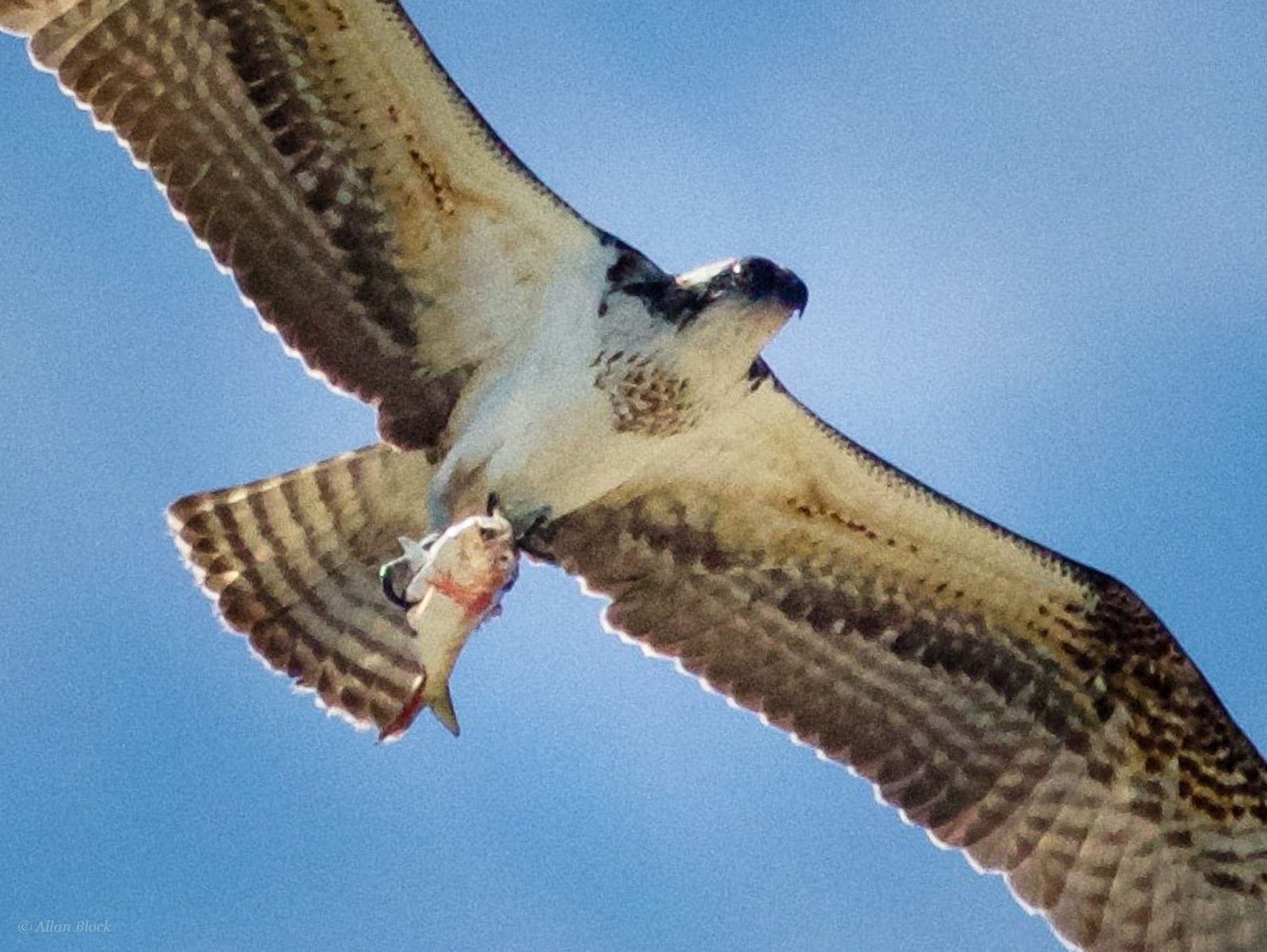
The Osprey's talons have evolved differently from other hawks. An Osprey's outer talon is reversible allowing it to grasp its slippery prey front and back. When flying they rotate the fish's head forward to minimize wind resistance.


Male and females look alike, although the female wears a brown 'necklace' across her breast.

Allan

Credit: 
Cornell Lab of Ornithology, All About Birds
Wikipedia


Wednesday, October 8, 2014

Fall Migration


The seasons are noticeably changing in Wisconsin. Cooler nights followed by crisper, shorter days have the birds moving again.

Canada Geese are the most recognizable birds overhead now. Constantly reorganizing their lopsided ‘V’, they make their presence known to each other and to us, too.

Honking seems to be their way of insuring inclusion in the group as they migrate south.


An osprey watches the Milwaukee River flow below. Long before ice will cover the river the ospreys will have departed.

Ospreys are known to migrate long distances and this one could easily be in South America for the winter. Ospreys need an ice-free environment to fish.

They fish with dramatic feet-first plunges into the water. Sharp talons and barb-soled feet hold fast a slippery fish.

When flying, they point the stupefied fish face-forward into the wind to reduce resistance.

It must be a surreal experience for the fish.

This Hermit Thrush was poised for a quick retreat if I came any closer. He looks to be a first year juvenile, newly on his own and unsure of whether to stay or go.  

Whichever and wherever, he will be leaving for the winter.

A ground foraging bird, the Hermit Thrush would find few resources in a snow-covered Wisconsin.

A Great Crested Flycatcher has caught a large aquatic insect, but his prey is putting up a struggle. He wants to eat it, but it won’t go down, so first he must tenderize his unmanageable mouthful.


Several well-aimed pile driver whacks on the head takes the fight out of his prey and the deftly dispatched delicacy is devoured.


This Eastern Towhee was passing through Wisconsin on his out-migration to somewhere else.

He stopped to inspect our lawn for seeds and whatever else he could find grazing in the grass.


The Eastern Towhee is a secretive ground dwelling bird. By planting both feet squarely in the leaf litter then hopping backwards, he drags a space clean, uncovering insects and invertebrates in the process.

He pounces on whatever he finds.


A young Northern Cardinal rapidly quivers his wings to his mother. She comes running with a seed to answer his call.  Now losing his downy feathers, this baby cardinal will be dependent on his parents for quite a while yet.
 

He could have picked up that seed himself, but he’s too young, too inexperienced or too unwilling to fend for himself.  Northern Cardinals are year round residents in Wisconsin.


A young Yellow-rumped Warbler caught a fly. It’s a tiny meal and it takes a lot of flies like this to satisfy even a small bird, but there are a lot of flies in the forest. Flies provide protein for birds.  A migration can be long and hard.  Protein is essential for birds and insects are the best source of protein for them.


A young male Common Yellowthroat preens and straightens his feathers. Preening is a daily exercise.

Yellowthroats are warblers that spend their winters in Central and South America. That is a long trip for this small warbler; so preening is important for warmth and fending off parasites.
   
You can tell he is a male by the dark patch starting to develop below his eye.

Common Yellowthroats are passing through Wisconsin right now. 


(Click any picture to enlarge)


The Monarch Butterflies are passing through, too.  Monarchs are so numerous they’re hard to miss. Monarch butterflies and wooly caterpillars are seasonal signs of the change.

The monarchs are on the way south, maybe all the way to Mexico.


Black-and-White Warblers don’t change much with the seasons.  They’re always formally attired in black and white. This is either a female or an immature male. Look for this bird hopping up or down a tree trunk.  Insects hide in the bark crevices, so that’s where they look for them.

If you miss the Black-and-White Warbler now, Florida may be your only chance to see another this year.

Fall is a special time in Wisconsin. The bird life changes almost daily. If you enjoy it, don’t miss it. It will be something to savor come January.

Allan

Saturday, June 8, 2013

Osprey


They were immediately upset when we arrived.

One Osprey was on the nest, the other one was circling it.  We were already within their comfort zone and only a hundred feet from the car.  

We hadn’t learned their boundaries, yet. Fred took cover behind the ball diamond’s dugout and I looked for a spot that would make them happy.

The sign informed us the Green Lake Lakers played baseball here.  It was quiet at 8:30 in the morning.  High atop the left field light standard two Ospreys had built a nest.  With their high angle view they saw everything coming or going.  We had no hope of arriving unnoticed.  I wondered about their choice of nest sites…busy town, ballpark, bright lights…seemed odd.  Not the ideal place to raise a family. 

It’s likely Ospreys don’t know anything about baseball.

Soon both were circling and calling in harsh grating voices, expressed their displeasure at us.  I wondered what they did on game nights with the lights lit and the crowd cheering.  

Oddly, after putting up with game noise, why would two quiet guys with cameras upset them so?

The Ospreys watched us intently.
They only quieted down when I moved further away from their nest site.  My friend, Fred, leaning on the dugout wall, was less conspicuous.  When their hawk-like vocalizations stopped I assumed they were satisfied.  
Osprey pairs look alike.  I can’t tell which is which, although one looks darker than the other. One bird is missing a feather on its right wing...noticeable in flight.  'Who's who' is known to them anyway…really.    I only became interested when it involved the sharing of a fish.   
Osprey #1 caught a fish and landed on a small manmade perch, nearby Osprey #2.  He/she landed with the fish and looked around, clearly in the mate’s sight.  The mate didn’t cry out for a share, but watched intently.  Osprey #1 proceeded to eat it. He/she ate the whole fish!  Bit-by-bit it was gone!  If he/she didn’t intend to share, why did he/she return to eat it in front of the mate?  Had the mate already eaten?   Maybe that’s putting way too much human emotion onto a bird, but for me it became an interesting observation…without an answer.  Now full of fish he/she made a couple of circles around the nest and disappeared for a half-hour. 

A possible answer came when Osprey #1 returned to the nest with a fish for the mate.  The transfer was made out of sight, but Osprey #2 leaves grasping a fish in its talons.  

Osprey #1 now settles down for a turn at incubating eggs. 

Ospreys are beautiful birds to watch.  They are sculpted, graceful and elegant in flight.

With a five to six foot wingspan they are not difficult to identify. They are mostly white under the wings, the 'armpits' and breast. 

Their wings make an M shape in flight.  

Capable of hovering, this unique species of hawk can wait for the precise moment to plunge into the water, feet-first for a fish.  They prefer shallow water, and can reach a fish three feet under the surface. 

Begrudgingly gracious in the long run, the Ospreys made Fred and I wait six hours for our pictures. 
We didn't complain though…not much. 
  
Allan